
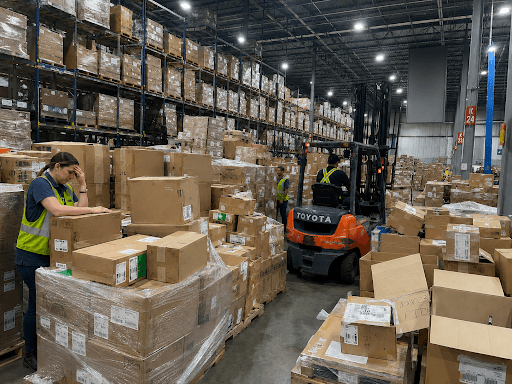
Manufacturers can manage excess stock by moving overflow inventory into a flexible warehousing partner that can store, track, rework, package, and distribute products as demand changes. This prevents production floors, aisles, staging areas, and dock space from becoming crowded while helping manufacturers avoid the cost and delay of permanent facility expansion.
The right overflow storage strategy is not just about finding extra square footage. Manufacturers need a system for deciding what should be stored, what should be reworked, what should be packaged, and what should be shipped. With the right partner, excess inventory becomes easier to control, easier to move, and less disruptive to daily operations.
Excess Stock Creates More Than a Space Problem
Inventory overflow starts with a simple issue: there is more stock than the facility can comfortably hold. But the real problem is operational. Once pallets, components, or finished goods begin taking over production space, teams lose efficiency. Aisles become harder to navigate, inventory becomes harder to locate, and dock areas become congested.
For manufacturers, this can slow down production, increase handling time, and create safety concerns. Products may be moved multiple times before they are finally shipped, inspected, repacked, or staged. Every unnecessary touch adds labor cost and increases the risk of damage, misplacement, or delay.
Warehouse overflow can also affect customer commitments. When finished goods are buried behind excess inventory or waiting for packaging changes, shipments may miss their intended windows. That is why inventory overflow storage solutions for manufacturers should solve more than storage capacity. They should protect production flow, inventory accuracy, and outbound fulfillment.
Common Manufacturing Triggers Behind Inventory Overflow
Excess stock often comes from normal manufacturing realities, not poor planning alone. A production run may finish before a customer is ready to receive the order. A retailer may delay a program launch. A seasonal build may require higher-than-normal inventory. Supplier minimums may force a manufacturer to receive more components than current production requires.
Packaging and labeling requirements can also create overflow. Products may be complete but not yet retail-ready. They may need kitting, assembly, repackaging, inspection, or updated labels before they can move into the next channel. In those cases, inventory is not truly idle — it is stuck between production and shipment.
This is where basic warehouse space may not be enough. Manufacturers often need contract packaging, warehousing, and distribution solutions that can handle the work required to turn excess stock into shippable inventory.
Diagnose the Inventory Before Choosing a Storage Solution
Before moving overflow stock, manufacturers should identify what each inventory group needs next. Not all excess inventory should be treated the same way. Some products need temporary storage. Others need packaging, rework, kitting, inspection, or immediate distribution.
A practical triage process can help. Store inventory if future demand is clear but timing is delayed. Rework it if products need relabeling, repackaging, inspection, or compliance updates. Kit or assemble it if components must be converted into retail-ready sets. Ship it if orders or distribution channels are ready. Review obsolete or slow-moving stock separately so it does not continue consuming valuable space.
This process helps manufacturers avoid turning overflow storage into long-term inventory neglect. The goal is not simply to move products off-site. The goal is to give every inventory group a clear next step.
Flexible Overflow Warehousing Adds Capacity Without Facility Expansion
Flexible overflow warehousing gives manufacturers scalable space without requiring them to lease, build, or reorganize their own facility. This is especially useful when inventory pressure is seasonal, program-based, temporary, or tied to uncertain demand.
Instead of investing in permanent square footage, manufacturers can use outside warehouse capacity for pallet storage, bulk storage, receiving, staging, and inventory control. This keeps production areas focused on production while excess inventory is stored in a more organized environment.
DIY Group’s warehousing and fulfillment services are designed to support companies that need reliable space, inventory control, and fulfillment support. DIY Group’s warehousing capabilities include more than 500,000 square feet of space, ERP technology for inventory control, RF inventory control systems, and the ability to package and ship over 200,000,000 pieces annually.
Rework, Kitting, and Packaging Turn Stuck Inventory Into Usable Stock
Many manufacturers do not have an overflow problem because products are unsellable. They have an overflow problem because products are unfinished from a logistics perspective. Finished goods may still need repackaging, labeling, display assembly, kit building, quality checks, or channel-specific preparation.
That is why packaging solutions are an important part of overflow inventory management. DIY Group supports primary packaging, point-of-purchase displays, and contract packaging. Its packaging page explains that manufacturers can ship bulk products and components to DIY Group, where inventory can be stored and prepared for shipment as customer orders are received.
This kind of support helps manufacturers recover value from inventory that would otherwise sit in staging areas. A product waiting for a label change, retail display build, or multipack configuration can become revenue-ready once the right labor and process are applied.
Inventory Visibility Keeps Overflow From Becoming Lost Stock
Overflow inventory is only useful if manufacturers know what they have, where it is, and what needs to happen next. Without visibility, excess stock can become hidden stock. Teams may reorder items they already have, overlook aging inventory, or lose time searching for products that should be ready to move.
A strong overflow storage solution should include inventory tracking, receiving accuracy, warehouse management discipline, and clear reporting. Flowspace identifies poor inventory control, inadequate overflow locations, irregular tracking, and inconsistent updates as common overflow storage issues.
For manufacturers, visibility is especially important because overflow inventory may include finished goods, components, packaging materials, work-in-process items, or products awaiting rework. Each category needs a clear location and status so teams can make accurate decisions.
Distribution Support Helps Excess Stock Keep Moving
Storage alone does not solve overflow if inventory still has no outbound path. Manufacturers need excess stock to move when customers, retailers, distributors, or ecommerce channels are ready for it. That makes distribution support a critical part of the solution.
DIY Group’s distribution services help connect warehousing with outbound execution. Its distribution page states that DIY Group uses Microsoft Dynamics to support receiving components, managing inventories, packaging products, and fulfilling electronic orders for finished goods. It also notes that DIY Group’s location can reach over 80% of the nation’s population and retail shoppers in one day.
When overflow storage, inventory management, packaging, and distribution work together, manufacturers can reduce bottlenecks. Excess stock does not just sit in a warehouse. It stays organized, prepared, and ready for the next shipping window.
The Right Partner Solves Storage, Labor, and Logistics Together
Manufacturers should evaluate overflow storage partners based on more than price per pallet. A capable partner should provide space, dock capacity, inventory systems, trained labor, quality controls, packaging support, and distribution capabilities.
Look for a provider that can receive inventory accurately, maintain visibility, handle high-volume projects, and adapt as your needs change. If your excess stock requires inspection, assembly, kitting, retail packaging, or shipment preparation, choose a partner that can perform those services without requiring multiple vendors.
DIY Group’s facility features include 558,000 square feet, 40 docks, and a location 40 minutes northeast of Indianapolis. Its quality control process follows cGMP best practices across receiving, warehousing, inventory management, picking, inspections, reporting, post-production disposition, and shipping.
Why DIY Group is Your Ideal Choice for Inventory Overflow Storage Solutions for Manufacturers?
DIY Group gives manufacturers a practical way to regain control of excess stock without slowing production or committing to unnecessary facility expansion. Through its warehousing and fulfillment services, manufacturers can access scalable storage, inventory control, and fulfillment support from a partner built around packaging, warehousing, and distribution. This makes DIY Group a strong fit for companies managing finished goods, components, seasonal inventory, promotional programs, or delayed outbound shipments.
DIY Group also helps manufacturers solve the work behind the overflow. Through packaging, kitting, assembly, rework, inspections, fulfillment, and distribution, DIY Group can help turn excess stock into inventory that is ready for the next step. For manufacturers that need more than space, DIY Group provides operational support that helps products move from storage to shipment with greater control and confidence.
Get Excess Stock Moving With DIY Group
Excess stock does not have to take over your production floor or stall your fulfillment process. With the right plan, manufacturers can separate inventory by purpose, store it securely, complete required packaging or rework, and move products when demand is ready.
If your team is running out of space, managing delayed shipments, or trying to prepare excess inventory for retail or distribution, DIY Group can help. Explore DIY Group’s industry-specific logistics solutions or request a custom quote for overflow warehousing, packaging, fulfillment, and distribution support.
FAQ
What is inventory overflow in manufacturing?
Inventory overflow happens when finished goods, components, packaging materials, or work-in-process inventory exceed the space or workflow capacity available inside a manufacturing facility.
What causes manufacturers to have excess stock?
Common causes include seasonal production, customer delays, supplier minimums, forecasting changes, large production runs, packaging delays, retail program changes, and products waiting for inspection or rework.
How does overflow warehousing help manufacturers?
Overflow warehousing gives manufacturers additional storage capacity while keeping inventory organized, visible, and ready for packaging, fulfillment, or distribution.
Is overflow storage only for seasonal inventory?
No. Manufacturers may also use overflow storage for delayed customer orders, promotional builds, new product launches, component surges, packaging projects, or temporary facility constraints.
Can excess inventory be repackaged or reworked before shipping?
Yes. With the right partner, excess inventory can be repackaged, relabeled, inspected, kitted, assembled, or converted into retail-ready inventory before shipment.
When should a manufacturer use a 3PL for overflow storage?
A manufacturer should use a 3PL when excess stock is disrupting production, consuming valuable facility space, creating tracking problems, or requiring additional labor for packaging, rework, fulfillment, or distribution.