
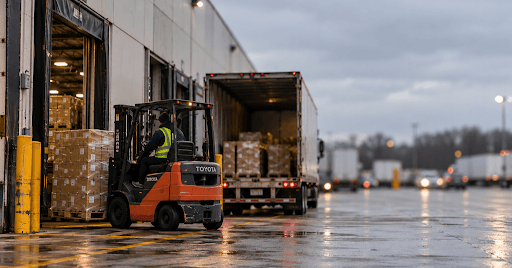
For Midwest manufacturers and distributors, a pallet waiting in storage can create costs without moving an order closer to delivery. Cross-docking changes that sequence. Incoming freight is checked, sorted, and transferred into outbound shipments with little or no long-term storage. When trucks, labels, and destination assignments are coordinated, the approach can lower storage and handling expenses, shorten facility dwell time, and improve trailer utilization.
Those gains are not automatic. A missed inbound appointment can delay several outbound loads, and additional transfers can erase the savings. The practical question is where cross-docking improves total distribution performance, not whether it is always faster than warehousing.
How Cross-Docking Works in Midwest Freight Distribution
At a conventional warehouse, received goods typically enter stock, wait for an order, then get picked and shipped. In a cross-dock flow, each arriving pallet already has a destination or routing instruction. Staff verify quantity and condition, scan or identify freight, stage it by outbound route, and load the appropriate vehicle. Some freight moves directly across the dock; other shipments wait in a short staging window.
For example, a manufacturer shipping palletized products to several Midwest retail locations might use a consolidation point. Rather than placing those pallets into reserve racks, the facility groups them by delivery lane and dispatches them on scheduled outbound trailers. This requires reliable arrival data and sufficient dock capacity.
DIY Group’s distribution services include order processing, retailer-specific shipping documentation, and outbound shipment coordination, capabilities relevant to accurate and efficient freight movement.
Where Cross-Docking Can Reduce Freight Distribution Costs
Spend Less on Storage, Not Every Facility Charge
Cross-docking reduces time pallets sit in inventory positions. If products already have confirmed buyers, avoiding reserve storage can lower space requirements, carrying costs, and inventory administration. The saving is smaller when freight would have occupied a dock only briefly anyway. Facilities still charge for receiving, sorting, and staging.
Cut Redundant Handling
Conventional warehousing often involves unloading, putaway, picking, travel between aisles, and reloading. A direct transfer eliminates some of those steps. Fewer touches can also reduce opportunities for damage, provided crews use proper equipment and pallet handling procedures. Poorly labeled shipments may instead consume more labor at the dock.
Consolidate Loads Intelligently
Combining compatible freight into fuller outbound trailers may reduce cost per pallet or delivery. Yet consolidating loads can introduce an extra stop, mileage, or a fee. Compare the all-in transportation invoice, including accessorial charges and missed appointments, rather than assuming that fewer outbound vehicles automatically mean lower costs.
DIY Group’s warehousing services provide another option when inventory needs to be held, tracked, or prepared before it moves.
How Cross-Docking Improves Freight Speed and Delivery Predictability
Every storage decision introduces a potential wait. When receipts are preassigned to outbound routes, workers can move freight through a scheduled transfer window instead of awaiting putaway, allocation, and picking. That can shorten dock-to-dispatch time, particularly for shipments with confirmed demand.
But a short cross-dock dwell does not guarantee an earlier delivery. A late inbound trailer, missed consolidation cutoff, limited carrier capacity, or retailer appointment constraints can push departure into the next day. Compare promised delivery dates and actual customer receipt times, not just timestamps inside a building.
Consider a hypothetical Indiana manufacturer supplying several Midwest retailers. Its carrier arrives before noon with labeled pallets; outbound pickups are arranged for that afternoon. If inbound scans and order data match, freight can be loaded without a storage cycle. If a truck arrives after its window, the facility needs a clear exception process.
DIY Group asks customers to coordinate pickup and delivery appointments before drivers arrive. That practice underscores the importance of predictable dock flow.
What Makes Cross-Docking Efficient, Accurate, and Compliant?
Shipment Data and Label Accuracy
Accurate transfers begin before a trailer opens. Purchase orders, advance shipping notices (ASNs), bills of lading, packing lists, and pallet identifiers should match physical freight. Retailers may require electronic data interchange (EDI) and particular barcodes. DIY Group describes flexible EDI capability and VICS-aligned systems on its distribution page.
When required by trading partners, GS1-128 barcodes can encode the Serial Shipping Container Code (SSCC) used to identify a logistics unit. These are industry and customer requirements, not universal federal labeling laws.
Workplace Safety and Freight Securement
Fast movement cannot bypass safety controls. At Indiana facilities, the Indiana Occupational Safety and Health Administration (IOSHA) oversees workplace safety. Relevant requirements corresponding to 29 CFR 1910.176 address material handling; 29 CFR 1910.178 addresses powered industrial trucks, including operator training and safe loading practices.
For applicable interstate commercial vehicle operations, Federal Motor Carrier Safety Administration cargo-securement regulations under 49 CFR Part 393, Subpart I address preventing load movement during transport. Responsibilities depend on the activity and party involved.
Product-Specific Quality Controls
For covered food transportation, FDA sanitary transportation rules may introduce additional requirements. Transportation of food completely enclosed by a container and not requiring temperature control for safety is generally excluded from those particular transportation provisions.
DIY Group identifies secondary packaging for dry food and beverages and states that its quality practices follow cGMP best practices. Requirements still depend on the actual product and handling activity.
Checks for damage, quantity mismatches, and incorrect labels help prevent downstream errors. DIY Group’s packaging services include inspection, labeling, and repackaging, work that must be planned rather than treated as instant transfer.
When Is Cross-Docking the Right Choice for Midwest Shipments?
Cross-docking is strongest for freight with known destinations, relatively stable volume, accurate inbound information, a narrow handling window, and outbound capacity already booked. Retail replenishment, scheduled promotional shipments, and manufacturer-to-store consolidation can be good candidates.
Use warehousing when goods must await orders, demand is uncertain, inspections take time, multiple packaging configurations are needed, or stock serves as a buffer against disruption. An overflow warehouse may be more economical than repeated failed cross-dock attempts. Hybrid flows can transfer committed orders while holding unallocated inventory.
The key question is how much freight is truly ready to move. Pallets needing relabeling, kitting, or repacking require a planned preparation step, not an assumed instant pass-through. DIY Group serves a range of industries, from retail and industrial products to dry food and personal care, illustrating why freight requirements differ by category.
How to Measure Whether Cross-Docking Is Delivering Value
Compare total costs for the same shipment mix and service commitment. Calculate net savings as avoided costs minus added costs over a representative period. Include storage, putaway, retrieval, and fragmented transportation on one side; cross-dock sorting, transfer fees, carrier changes, and exception handling on the other. Distinguish recurring savings from one-time implementation expenses.
For illustration only, suppose a shipper projects $1,600 in avoided monthly storage expenses, $900 in eliminated putaway and retrieval labor, and $1,200 in transportation savings from consolidation. New processing fees cost $1,100, transfers add $500, and expected scheduling exceptions cost $300.
Estimated monthly net savings = ($1,600 + $900 + 1,200)-(1,100 + $500 + $300) = $1,800.
These figures are hypothetical, not DIY Group results or industry-standard rates.
Then monitor cost per pallet, receipt-to-departure dwell time, trailer utilization, on-time delivery, and damage or misrouting rates. Evaluate several weeks, including peak demand, to capture operational variability. Savings only count if customers still receive the right freight on time.
Frequently Asked Questions About Midwest Freight Cross-Docking
Can Cross-Docking Work for Smaller Freight Shipments?
Yes, when several smaller shipments can share an outbound route or destination. Consolidation benefits must exceed handling and additional transportation costs. Small, irregular loads may not justify a dedicated transfer process.
What Happens if an Outbound Truck Misses Its Scheduled Arrival?
Freight may need temporary staging, a replacement vehicle, or a later appointment. Clear cutoff times, escalation contacts, and staging space can prevent one missed pickup from disrupting unrelated shipments.
Can Shipments Requiring Relabeling or Repackaging Still Use Cross-Docking?
Sometimes. A planned labeling or repackaging step may fit within a short transfer window, but extensive rework generally favors warehousing or a hybrid workflow.
Is Cross-Docking Appropriate for Seasonal Retail Distribution?
Potentially, especially when destinations and shipping windows are confirmed. Inventory awaiting final orders may still need storage. Promotional launches require realistic capacity planning rather than assuming all products can move immediately.
Build a Distribution Strategy Around Your Freight
The best approach balances avoided storage against transfer costs, delivery reliability, and product requirements. For Midwest shippers, understanding those trade-offs matters more than an unsupported promise of faster delivery.
DIY Group provides warehousing, packaging, and distribution services from its Indiana operations. If you’re reviewing shipment schedules, retailer documentation, or inventory handling, contact DIY Group to discuss requirements and identify an approach suited to your products and delivery commitments.